
What Does a D20 Do in D&D? A Beginner’s Guide
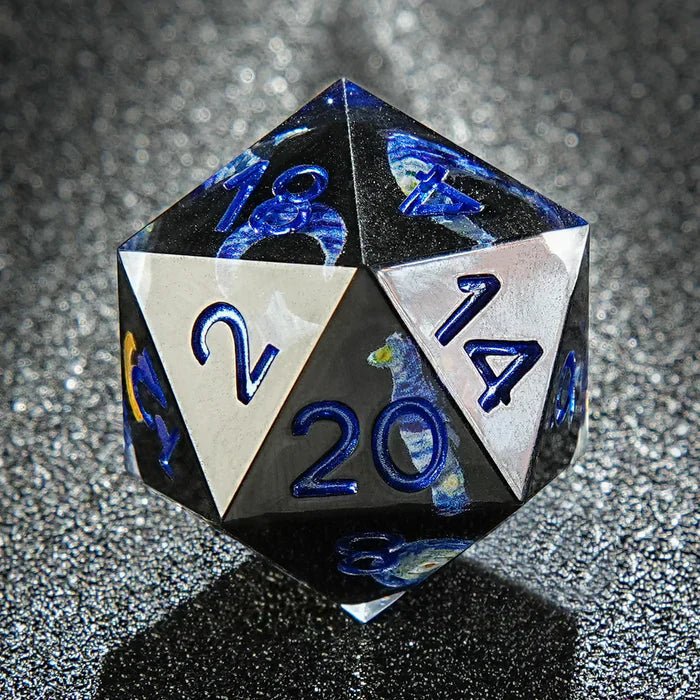
A D20 is a twenty-sided die, and in Dungeons & Dragons it is the central die for resolving uncertain actions. Under the 2024 D&D Basic Rules, a D20 Test covers an ability check, an attack roll, or a saving throw. The player rolls a D20, adds the relevant modifier, and compares the result with a target number or the other rule that applies. The exact rule can vary by game and edition, so this guide names the 2024 Basic Rules when describing D&D mechanics.
What does “D20” mean?
The letter “D” is shorthand for “die,” and the number identifies how many faces the die has. A D20 therefore has twenty faces, usually numbered from 1 through 20. RPG notation combines a quantity and a die type: for example, 1d20 means roll one twenty-sided die, while 2d6 means roll two six-sided dice. The notation is widely used in tabletop games, but the game’s own rules determine what a roll means.
Most D20s are shaped as an icosahedron, a solid with twenty triangular faces. A die’s printed numbers help you identify the result; they do not themselves tell you whether the action succeeds. The rules, the character’s modifiers, and the target number complete the procedure.
The three D20 Tests in D&D
Ability checks
An ability check resolves an uncertain attempt such as searching a room, recalling a clue, persuading a guard, or climbing a difficult surface. The Dungeon Master decides whether a roll is needed and which ability or skill applies. The player rolls the D20, adds the relevant modifier, and compares the total with the Difficulty Class (DC) set by the rules or the DM. A larger total is generally more likely to meet the DC, but a check can have additional circumstances or specific rules.
Attack rolls
An attack roll determines whether an attack hits its target. The attacker rolls a D20 and adds the modifiers required by the weapon, spell, feature, or other rule. The total is compared with the target’s Armor Class (AC). If the result meets or exceeds the AC, the attack hits. Damage is usually resolved with other dice after a hit, according to the attack’s description.
Under the 2024 Basic Rules, a natural 20 on an attack roll is a Critical Hit and a natural 1 misses regardless of modifiers. That special treatment is specific to attack rolls in those rules; do not automatically apply the same rule to every ability check or saving throw.
Saving throws
A saving throw represents resisting or avoiding an effect, such as a spell, a trap, or a hazard. The player rolls a D20, adds the appropriate saving throw modifier, and compares the result with the effect’s DC. Some effects still have partial consequences on a successful save, so read the effect itself instead of treating every save as an all-or-nothing event.
How modifiers change the result
Many D&D rolls combine the die result with a modifier. A character’s ability score, proficiency, equipment, class features, or other game rules can affect the total. A modifier is added to or subtracted from the face value shown on the die. For example, if a rule calls for a D20 Test with a +3 modifier and the die shows 12, the total is 15. Whether 15 succeeds depends on the target and the test’s rule.
This distinction helps new players avoid a common mistake: the number showing on the die is not always the final result. Announce both the face value and the total when you roll, especially while learning which bonuses apply.
Advantage and Disadvantage
When a rule gives you Advantage or Disadvantage on a D20 Test, you roll two D20s instead of one. With Advantage, use the higher result; with Disadvantage, use the lower. The rule normally does not mean you add both dice together. If the same roll has both Advantage and Disadvantage, the 2024 Basic Rules treat them as cancelling each other, leaving a single D20 roll, subject to any other rules that apply.
Keep the two dice visually distinct if you use different colors or sizes, and decide before rolling which one represents each result. This avoids confusion when several players roll at once.
When a D20 is not the right die
D&D uses other dice for different jobs. A D4, D6, D8, D10, D12, or percentile combination may determine damage, healing, random tables, or other effects. The expression “1d8 + 3,” for example, means roll one eight-sided die and add three. A D20 is not automatically rolled for every action; the rules may call for another die or no roll at all.
Other RPG systems may use a D20 differently or may use percentile dice, pools of six-sided dice, or no polyhedral dice at all. If you are playing a game other than D&D, use that game’s rulebook rather than carrying over D&D assumptions.
Choosing a D20 you can read and use
For a physical D20, start with legible numbers. Contrast between the numerals and the die body matters more during a dim game night than a product photo suggests. Check that the die is sold as a single D20 or as part of a set, and compare the size with the dice you already own. If you use Advantage often, two similar-sized D20s can make paired rolls easier to track.
Appearance is personal: colors, inclusions, metal finishes, and themed artwork can make a die feel connected to a character or campaign. Do not infer a die’s fairness or precision from its material or appearance alone. For a normal home game, follow your group’s agreed rolling practice and use the rulebook for the procedure.
Browse single D20s or D&D dice sets if you want to compare styles. NPCDICE also has a beginner’s guide to choosing a first D&D dice set for the broader buying decision.
Frequently asked questions
Does rolling a 20 always mean success?
Not for every D&D roll. Under the 2024 Basic Rules, a natural 20 has a specific critical-hit result on an attack roll. Ability checks and saving throws follow their own rules and target numbers.
Does a D20 have to be rolled for initiative?
In the 2024 D&D Basic Rules, initiative is determined by a Dexterity check, which normally uses a D20. The rules glossary also describes an initiative score that a DM might use instead of rolling.
What is a “natural 20”?
It means the die itself shows 20 before adding modifiers. The phrase distinguishes the face value from the final total. Its effect depends on the specific rule being used.
Use the die and the rule together
A D20 is simple to recognize, but its result only makes sense in context. Identify the test, roll the correct die, add the relevant modifier, and apply the rule for that game and edition. For exact D&D procedures, consult the official 2024 Basic Rules: Playing the Game. The die supplies a number; the table’s rules explain what happens next.


